From Forge
to Shop Floor
The tire technician is the direct descendant of the village blacksmith — the same trade, handed down across 500 years and four ways of getting around, still keeping the community rolling.
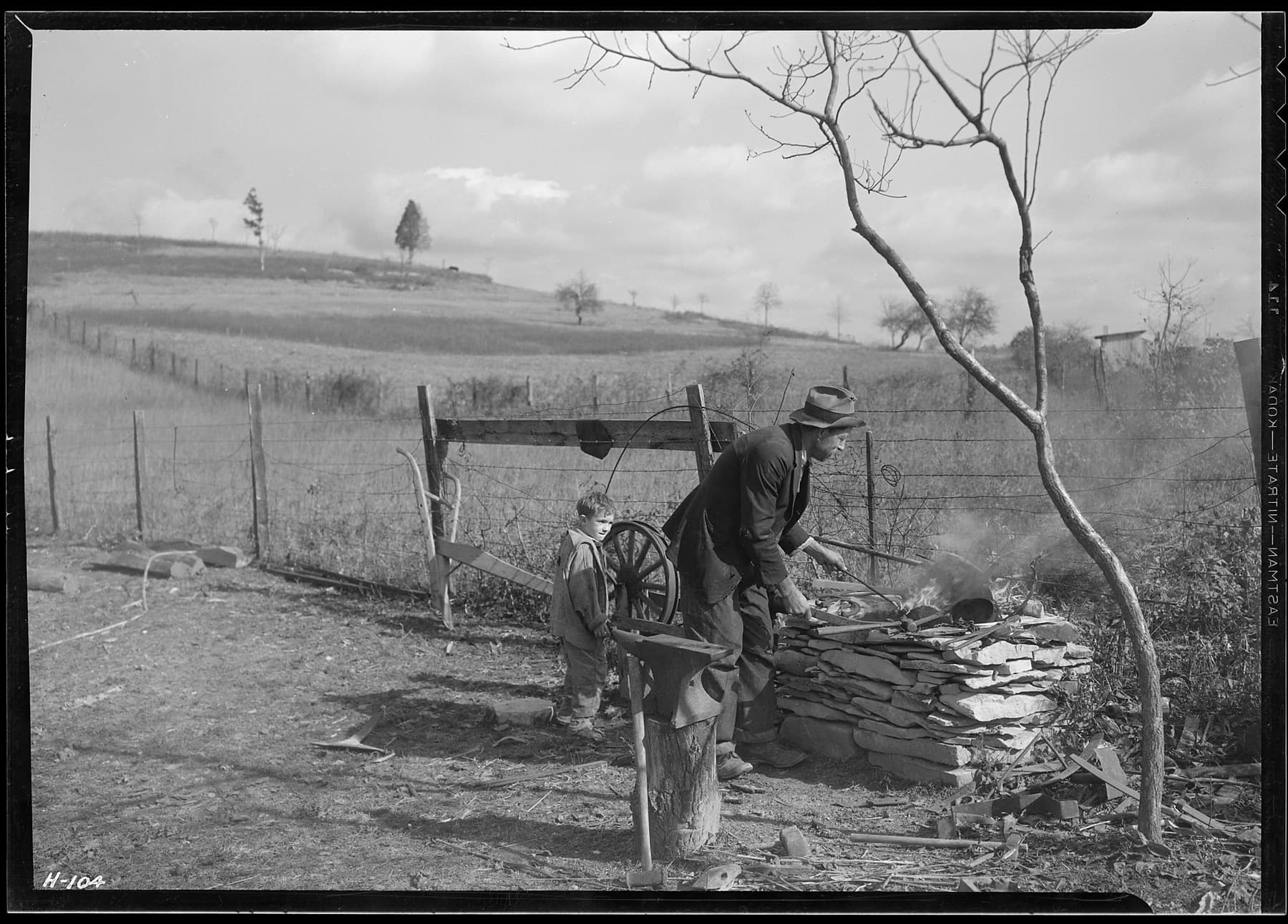
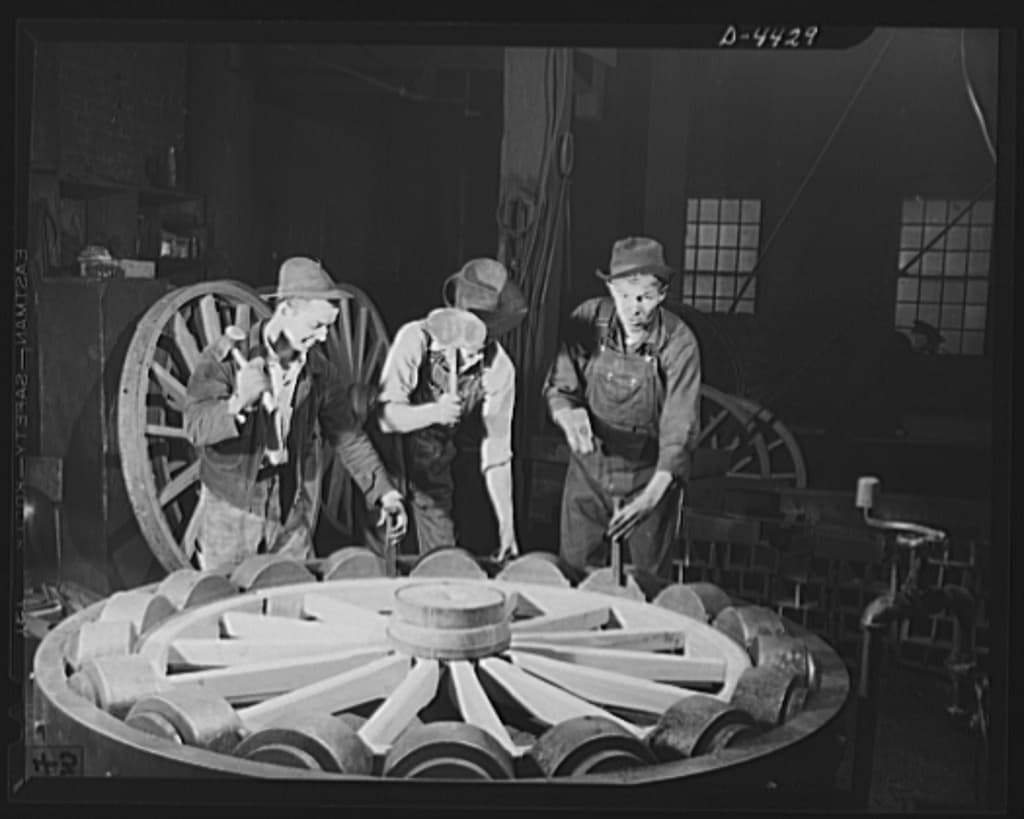
The word tire comes from attire — the iron dressing a smith shrink-fit onto a wooden wheel. When rubber replaced the iron band, it kept the name.
Above: fitting a hot steel tire onto a wooden wheel — the literal “tiring” operation that gave the tire its name.
The role never changed. Only the machine did.
The Village Smithy
For most of recorded history the smithy was the closest thing a town had to a transport-maintenance depot. The country blacksmith was usually also the farrier — the specialist who shod horses — and he worked hand-in-glove with the wheelwright who built the wooden wheels. One contemporary called him a man 'not only a blacksmith and farrier, but, at times, wheelwright, carpenter, tinker, veterinary surgeon.' He was the trusted pair of hands the whole community relied on to keep moving.
The Transition
Two inventions changed everything: Charles Goodyear's vulcanized rubber (1839) and the practical pneumatic tire — patented by Dunlop in 1888 and fitted to automobiles by the Michelin brothers in the 1890s. The safety-bicycle boom came first, with U.S. bicycles in use jumping from an estimated 200,000 in 1889 to a million by 1899, creating the first mass demand for rubber tire repair. Then the automobile finished the job.
Industrialization
The single village trade split in two. Manufacturing concentrated in Akron — Goodyear, Firestone, Goodrich, General. Service and retail became a trade of its own: Firestone's 'one-stop master service stores' and the independent 'vulcanizing shops' of the era were the direct ancestors of the modern tire shop. Meanwhile the horse economy collapsed, and the old smithy collapsed with it.
The Modern Tire Tech
Today 'Tire Repairers and Changers' is a formally recognized trade — a hands-on craft that mounts, balances, and repairs the one thing that actually meets the road. National chains and single-location independents stand side by side, and the language of the trade — 'family owned,' 'trusted local,' 'keep life moving' — is the 21st-century echo of the village smith.
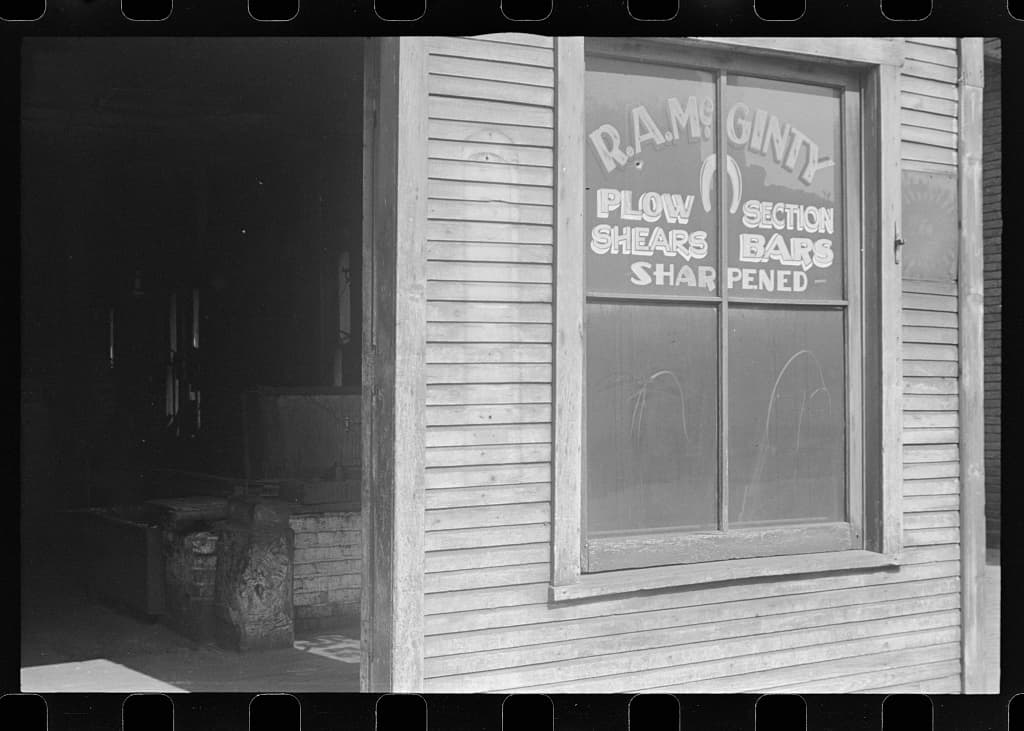
The lineage is literal
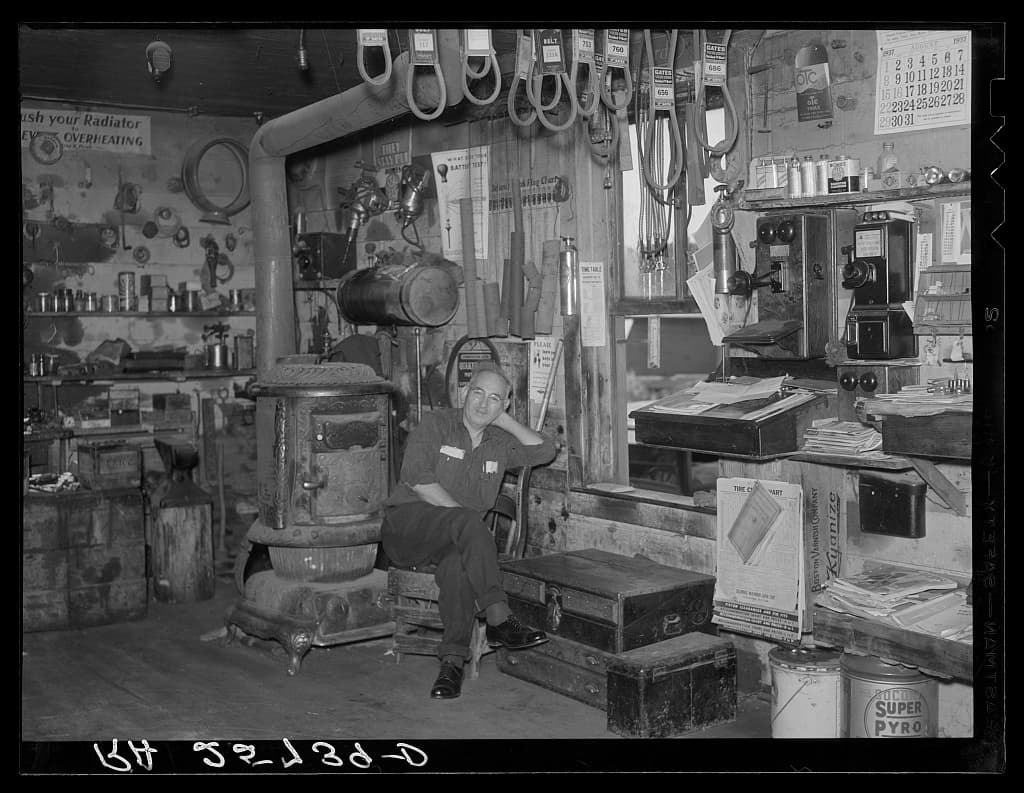
Between roughly 1900 and 1930, blacksmith shops across the country didn't close — they retooled. Again and again, the same building and the same family added a vulcanizing room, installed a gas pump, and became the garage.
Andover, MA
The 1913 Myerscough & Buchan garage was purpose-built as a 'modern full service automobile garage' — and it included a blacksmith shop and a dedicated room for vulcanizing.
Brookline, MA
In 1916 the horseshoer Frank Turner replaced his wood-frame smithy with a brick auto garage selling gasoline and repairs. It later housed a shop called 'International Tire.'
New Boston, NH
McLane's Blacksmith & Carriage Shop shared space with a car garage and a hand-cranked gas pump after 1910 — the old carriage ramp still in place.
Eden, UT
The Wilbur & Son blacksmith shop, founded in 1893, was shifted 'from Horse Powered to Engine Powered transportation' in the early 1900s, becoming an early gas station.
One role, carried hand to hand
The iron 'tire' band became the rubber tire. The rubber part literally inherited the name of the iron hoop it replaced.
Blacksmith, farrier, and wheelwright became the early garage mechanic and vulcanizer, and then the tire technician. Same role, new tools.
The forge — fire, hammer, anvil, quench — gave us the words. 'Tiring a wheel' was a hot forging job; it became 'changing a tire.' Even 'tire iron' first meant the iron band itself.
Four eras. Four technologies. One unbroken trade.
The local, trusted, hands-on craftsperson who keeps the community moving never went away — the tools just changed. Treadforge builds the next set of tools for the people who carry that trade forward.
- Blacksmith at his forge — Lewis Hine, 1933. U.S. National Archives (public domain).
- Fitting a steel tire to a wooden wheel — Office of War Information, 1942. Library of Congress (public domain).
- Village blacksmith shop, London, Ohio — Ben Shahn, 1938. Library of Congress, FSA (public domain).
- Blacksmith's shop turned into a garage, Cambridge, Vermont — 1937. Library of Congress, FSA (public domain).
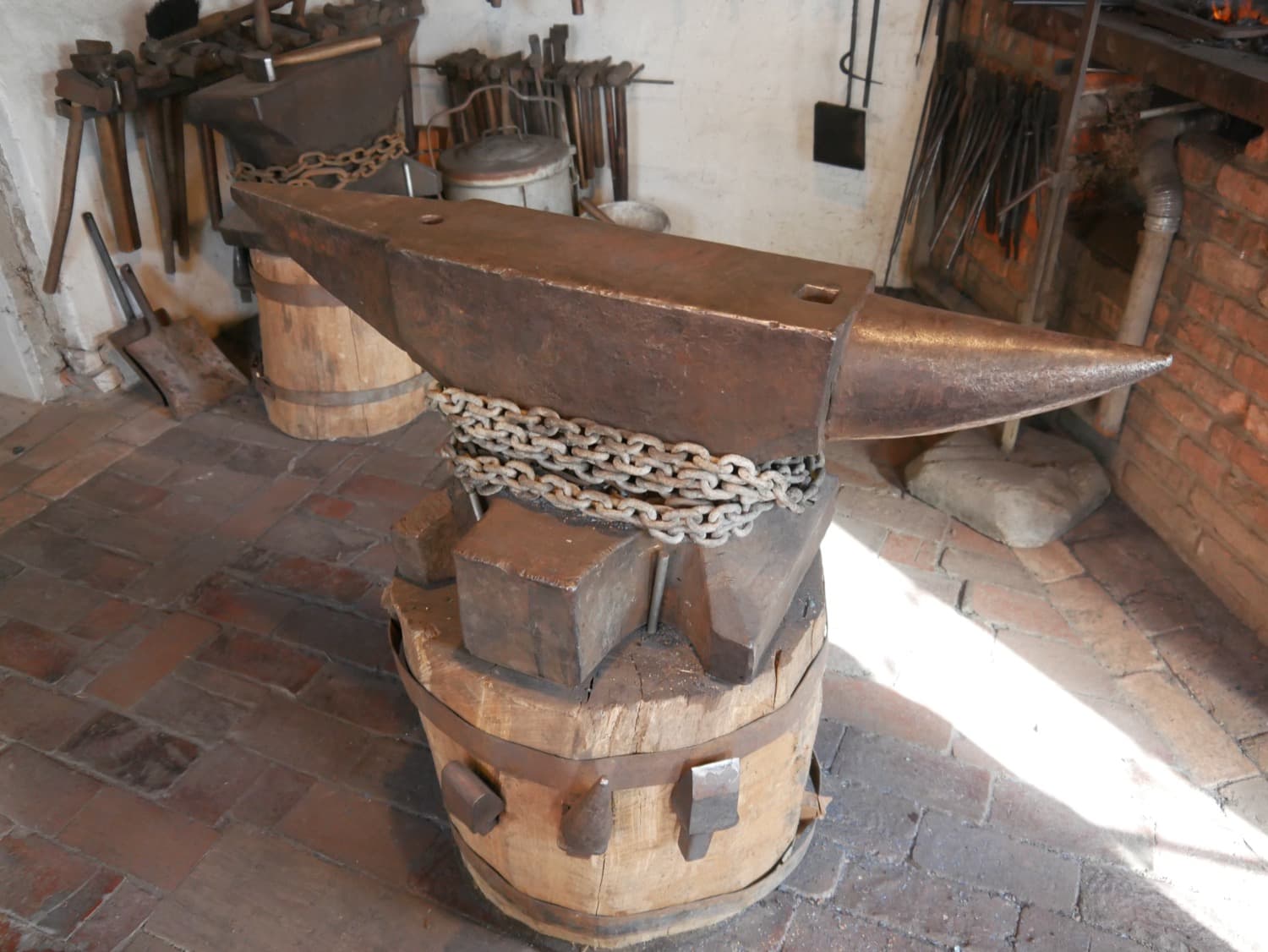
- Blacksmith's anvil — Wikimedia Commons (CC0).